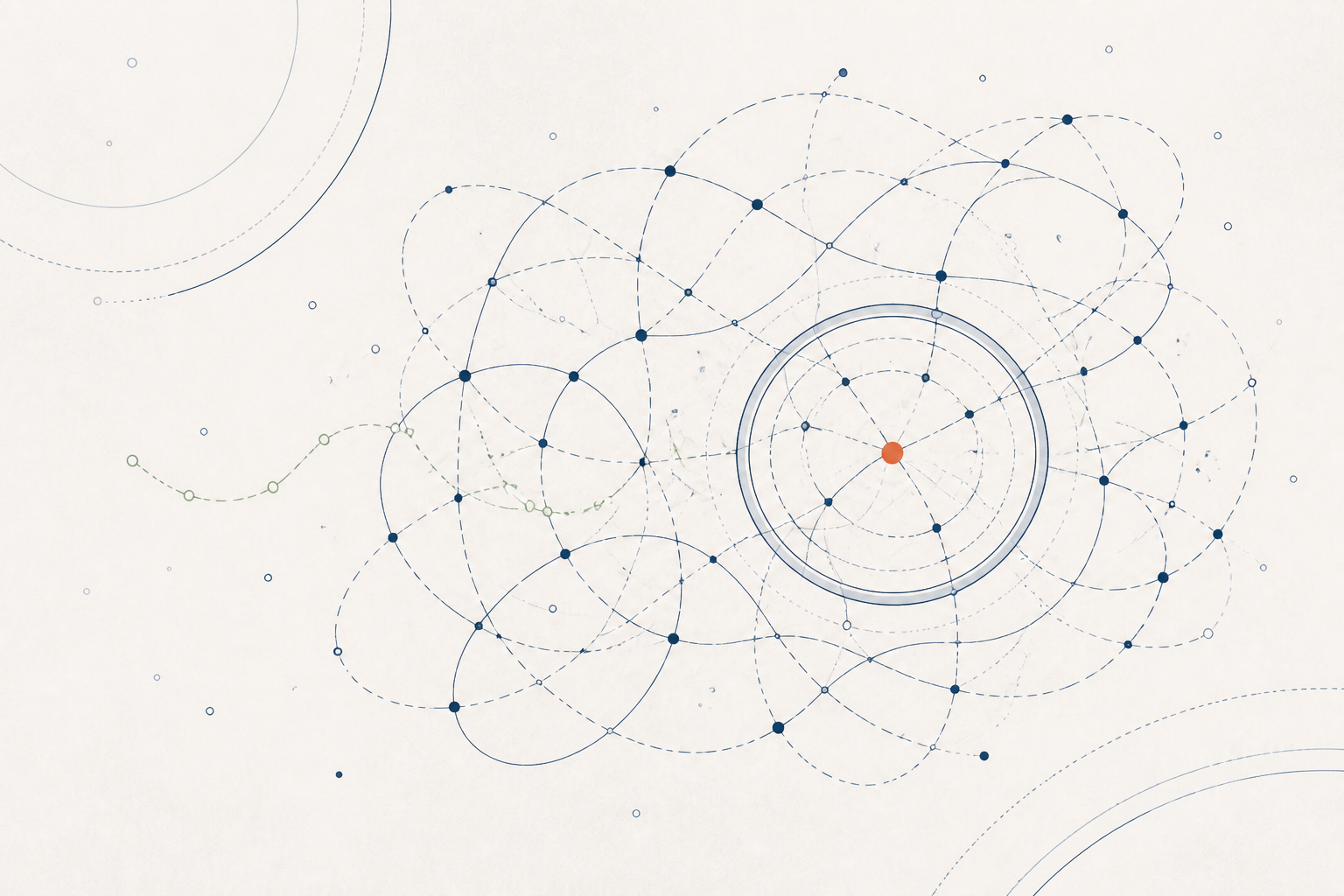
How this flexibility of closure practice works
TracePair Field is a browser practice game about recognizing a small remembered structure inside a larger connected drawing. Each session contains ten rounds. In Baseline mode, you see one target. In Advanced mode, you see Target A and then Target B. After the selected exposure period, the target disappears and a dense line field appears. Your job is to answer whether the relevant target, or both targets in Advanced, is actually embedded in that field.
Start with one target, then add a second
Baseline is the clearest way to learn the interaction. Choose an exposure of 2.5 seconds for your first run, press Begin 10 rounds, and look at the target as a relationship between connected edges rather than as a picture with a name. When the field appears, inspect junctions, turns, and edge direction. A target can be part of a larger graph, so extra lines attached to its vertices do not automatically make it absent.
Advanced introduces a short sequence: Target A appears, then Target B, then the field. A Yes answer is correct only when both complete targets are present. Negative cards are balanced: half omit A and half omit B. The missing target is replaced by a near-shape decoy rather than an empty area, so a quick decision based only on density should not solve the round.
Use the exposure controls deliberately
The three exposure choices are 0.8, 1.5, and 2.5 seconds. They control how long each target remains visible; they do not change the field, the answer, or the scoring rule. Start at 2.5 seconds to understand the shapes. Move to 1.5 seconds when your inspection is consistent. Use 0.8 seconds only when you want a faster presentation, not because a shorter time is inherently better.
Every session is ten rounds, which keeps the result easy to read without pretending to be a standardized test. Correct answers add to the score. A false positive means you answered Yes when the required target was absent. A false negative means you answered No when the required target was present. These error names describe choices inside this game only.
Read the exact answer reveal
After every answer, the field remains visible and the actual target location is drawn on top of it. Target A uses coral and Target B uses sage. If a target is absent, the reveal says so instead of pointing to a convenient look-alike. This matters because the goal is not to reward an unexplained guess. You can compare the remembered edges with the highlighted edges, see which turn or junction you missed, and then move to the next round.
The reveal uses the same edge coordinates as the generator and gold answer. It is not a manually placed decoration. Each positive target has exactly one validated occurrence. Each negative target has zero occurrences. The field remains one connected graph, all embedded target vertices have at least one external incident edge, and every card stays inside the same five-by-five field bounds.
What the forty-card pool guarantees
The clean-room pool contains forty unique fields: twenty Yes and twenty No. Every field contains twenty-six edges and one connected component. Yes/No pairs are balanced for vertex count, horizontal edges, vertical edges, and maximum degree. A separate field-only leakage check holds out each Yes/No pair and tests simple layout shortcuts without looking at the targets. The strongest preregistered decision stump reaches 57.5 percent and the strongest multivariate sensitivity model reaches 52.5 percent, both under the 60 percent release gate.
These controls show that the supplied cards meet the game's documented structural rules. They do not establish equal perceptual difficulty, population norms, transfer to other tasks, or a validated cognitive construct. The generator, committed snapshot, gold-answer tests, leakage check, and forty-card human visual sign-off are kept together so future edits can be detected.
Local history and replay
At the end of a session, TracePair Field stores only a small local record in your current browser: date, mode, exposure, correct count, false positives, and false negatives. At most five records are kept. There is no account, cloud profile, leaderboard, or cross-device sync. Clearing this site's browser storage removes the history.
Replay shuffled set starts a new ten-round selection from the validated forty-card pool. A replay is useful for practicing the same rule with a different order; it is not a claim that the game generated a new psychometric form. If you want to change mode or exposure, return to setup before the next run.
Scope: a game, not a diagnosis or employment tool
This site is for practice and entertainment. It must not be used to diagnose, screen, rank, certify, or make decisions about anyone. A score does not measure intelligence, attention capacity, cognitive health, workplace suitability, academic potential, or readiness to drive or operate equipment. TracePair Field has no clinical validation, normative sample, medical supervision, or hiring-assessment purpose.
If a visual, neurological, or cognitive concern affects daily life, use an appropriate qualified professional and established clinical process rather than this game. Do not use another person's result for school, work, insurance, medical, legal, or access decisions. The Terms state these limits, the Privacy page explains local history and optional analytics, and the Contact page provides a public issue-reporting route.